Publications
Enabling Ecosystems for Young Women's Digital Inclusion
2023
Rwanda’s commitment to leveraging ICT to accelerate growth and poverty reduction catalyzes great progress. However, there continue to be low levels of adoption of digital tools and services and limited human capacity to reach the goal of building a knowledge economy, attributable to low levels of digital literacy and skills among Rwandan citizens, particularly young women. These challenges stand to widen the existing gaps in employment and entrepreneurship for young women. Pivotal to tackling the gender digital divide is an enabling ecosystem.
Based on the community-based action research by young researchers, the Enabling Ecosystems For Young Women’s Digital Inclusion research brief explores the barriers young women face in building skills and experience in digitally enabled livelihoods, social innovation, and what policies, programs and/or approaches would better support their needs and priorities.
Enabling Ecosystems for Young Women's Social Innovation
2023
The gender digital divide is persistent, and young women face overlapping barriers that limit their ability to apply their knowledge and skills to advance their careers, businesses and harness opportunities for leadership.There is an urgency to address the lack of access, safety and inclusion for young women in the digital economy, and this requires an ecosystem approach through which stakeholders work together to to learn, iterate, and improve how we all serve the communities we work with in order to more impactfully support young women on their social innovation journey.
Featuring insights and recommendations from young women researchers, the Enabling Ecosystems For Young Women’s Social Innovation research brief amplifies the young women-led community based research findings of DOT Tanzania’s Gender and Digital Skills Working Group (GDSWG), made up of local partners in the digital inclusion and youth livelihoods sector to create space and opportunity for collaborative learning and action.
Creating Transformative Youth Digital Spaces: ICT for Youth Employment, Education, and Climate Change
2022
Over the past 20 years, DOT has witnessed the inspiring ways in which young people use technology to start and scale businesses, learn new skills, and impact their communities. With an unwavering commitment to digital inclusion, DOT is now exploring how its youth-led model could be applied in different sectors to create solutions at scale.
At the 2022 Tanzania Youth Digital Summit, over 3,800 young people and ecosystem stakeholders came together to discuss ICT for youth employment, education, and climate change. DOT believes that digital inclusion and gender equality are key to ensuring all youth have the opportunity to bring their creative energy and ideas to problem-solve in these spaces.
This report shares youth and stakeholder voices from TYDS 2022 and outlines the steps that should come next to ensure everywhere is a transformative youth digital space.
Digital Skills for Youth Employment and Entrepreneurship
2021
Imagine yourself at Kariakoo market, one of Dar es Salaam’s bustling commercial hubs. There’s the beauty salon owner offering manicures; a young woman selling cashews and jars of homemade nut butter; a dozen wakala agents advertising phone vouchers and punching money transfers into their feature phones.
Less visible are the ways in which digital skills are permeating this scene: behind her sewing machine, a tailor browses photos of dresses on Instagram; a business owner buys purses in wholesale so he can sell them via WhatsApp status back home in Morogoro; a mobile phone fundi learns how to fix the latest iPhone from a YouTube video.
For youth in Tanzania, two truths emerge from this description. The first is that mobile phones remain the entry point into the digital economy; second is the reality that digital skills are no longer optional.
And yet, the question remains: how can we ensure we leave no one behind?
Case Study: Virtual Coaching for Youth Social Innovators
2021
This case study provides an overview of an entirely virtual coaching pilot initiative with members of the #DOTYouth Street Team.
The coaching pilot was developed and delivered in partnership with Coach Africa, and focused on supporting members of the #DOTYouth Street Team to develop SMART goals and action plans to strengthen and build resilience in their community-based initiatives as they transitioned out of the #DOTYouth Street Team program.
The case study outlines key learnings, methodologies and recommendations for establishing a virtual coaching model for young social innovators.
The Digital Shift: Youth Voices on Digital Inclusion and Skills
2020
Youth, especially young women, face a multitude of challenges when it comes to securing opportunities in the digital economy. COVID-19 is just the latest, and a goal of Tanzania Youth Digital Summit was to explore the effects of the pandemic on youth-led enterprises, livelihoods, and digital skills.
The Digital Shift: Youth Voices on Digital Inclusion and Skills report amplifies youth voices, sharing the barriers they face, the aspirations they hold dear, and the ways in which DOT and other partners can better support them as they journey through the digital shift. Findings in this report will inform DOT’s programming to meet the unique needs of young changemakers and social entrepreneurs.
Youth Voices: Youth-Led Social Entrepreneurship in East Africa and the Middle East
2019
A report by DOT’s Youth Leadership Advisory Board (YouthLAB)
The rise of social entrepreneurship is changing the nature of work and the face of development in countries around the world. This research, conducted by DOT’s YouthLAB, demonstrates that – with ecosystems of support, mindsets, digital skills, and social enterprise encouragement – youth are delivering economic and social impact in their communities. This report provides insights into how youth in Ethiopia, Kenya, Lebanon, Rwanda, Tanzania and Uganda are harnessing opportunities and navigating their social innovation journeys, and presents the struggles and triumphs of 101 youth social entrepreneurs.
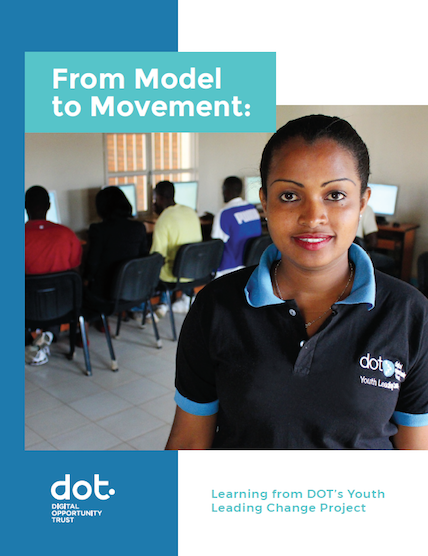
From Model to Movement: Learning from DOT's Youth Leading Change Project
2018
From Model to Movement provides evidence of the impact and effectiveness of the DOT youth-led model – a model that has been refined over the past 15 years to international acclaim – as well as insight into the ambitions and needs of young people in a rapidly changing world. It recognizes the desire of DOT youth to lead practical change in their communities through social innovation, human-centered design thinking and effective community projects, and outlines DOT’s commitment to putting youth at the center. DOT’s ultimate measure of success is when young women and men themselves take over the reins of change and development – shifting DOT’s work as well as global development from model to movement.
Youth Voices: Digital Lives and Livelihoods
2016
Led by young local researchers who are deeply familiar with their communities, this report investigates how youth in Africa, the Middle East, and Indigenous Canada are accessing and using technology for work, education, entrepreneurship, learning, leadership, and, of course, fun.
As natural early adopters of technology, digital natives, and the biggest demographic population in the world, young people are already transforming economies and leading change in ways that are tremendously impactful, but not always visible. Our youth researchers explored how their peers are using technology as change-makers and entrepreneurs, as well as the barriers to access that prevent many young people from taking full advantage of digital opportunities.
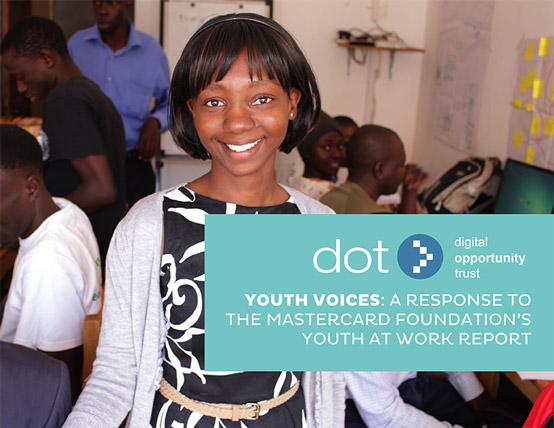
Youth Voices: A Response to The MasterCard Foundation's Youth at Work Report
2015
The MasterCard Foundation’s report, “Youth at Work: Building Economic Opportunities for Young People in Africa,” is an important contribution to the growing body of knowledge about youth economic engagement, and it closely reflects DOT’s experience as a leading practitioner.
DOT has a global network of passionate, engaged young people who are eager to participate in dialogue about the issues that impact them the most. We shared The MasterCard Foundation’s report within our network of young leaders, invited them to comment, and engaged them in discussion around the core themes of the report.
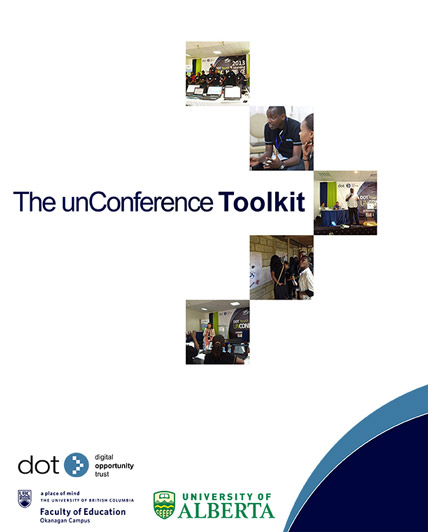
The Unconference Toolkit
2013
The Unconference Toolkit was developed in preparation for DOT’s first Youth Unconference in Nairobi, Kenya in May 2013.
DOT’s Unconference is designed to create opportunities for dialogue between youth and the public, private, non-profit, and academic sectors. This toolkit contains resources that we have curated and created to help you lead your own inclusive, youth-led Unconference.
View more of our work: Programs Publications
Stay Updated
Keep informed about what DOT is up to!